Welcome to GCC's redesigned website! Take a look around and enjoy what’s new. Have feedback? Tell us what you think—complete
our quick feedback form.Share your feedback!
Planning is a crucial process by which the college accomplishes its mission. This
online Glendale Community College Integrated Planning Handbook describes the processes
for long-term and short-term planning, evaluation, and resource allocation.
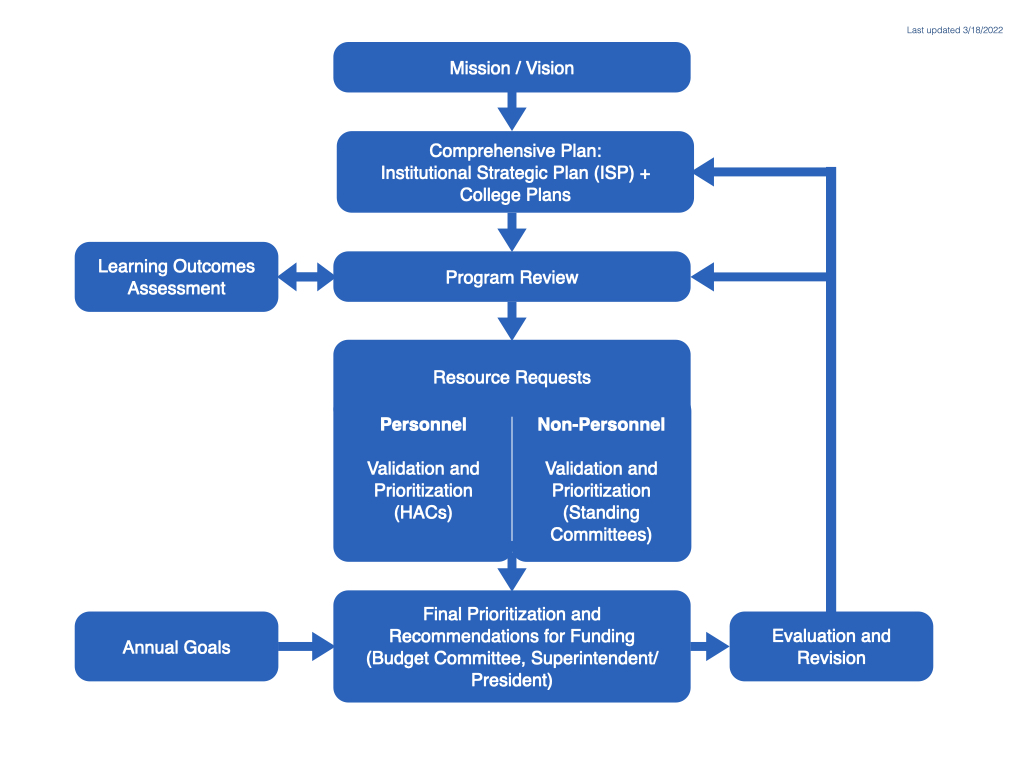
Mission/Vision. The mission statement describes how the college helps students achieve their goals.
It serves as the foundation for college planning, evaluation, decision-making, and
resource allocation. The vision statement describes what the college aspires to be.
Comprehensive Plan. The college’s Comprehensive Plan includes the Institutional Strategic Plan as well
as supporting institutional plans such as the Facilities Plan, Technology Plans, Distance
Education Plan, etc. These plans define the college’s institutional long-term goals.
Program Review. Program review is the primary mechanism for departmental self-evaluation. These reviews
allow for long-term and short-term planning at the departmental level. They also provide
an avenue for and support resource requests. Beginning in 2015-2015, the program review
cycle moved to a three-year cycle. Each year, one-third of programs undergoes a full
program review while the remaining programs review and update their program review
document.
Resource Allocation. Resource requests are validated and prioritized through the hiring allocation committees
and governance committees. These committees make recommendations for funding at the
end of the annual cycle.
Evaluation. Every year, the integrated planning process is evaluated and improvements are made
for the next cycle.
Integrating Planning, Program Review, and Resource Allocation
Accreditation Standard 1.4. The institution’s mission directs resource allocation,
innovation, and continuous quality improvement through ongoing systematic planning
and evaluation of programs and services. (ACCJC Guidance on Evidence: Institutional
systems for planning are integrated such that information from program planning/program
review informs processes for resource allocation, decision-making, and short- and
long-term operational planning. Evidence of prioritizing and funding resource allocations
that arise through program review.)
Accreditation Standard 3.5. The institution’s mission and goals are the foundation
for financial planning. Financial information is disseminated to support effective
planning and decision-making and provide opportunities for stakeholders to participate
in the development of plans and budgets. (ACCJC Guidance on Evidence: Documentation
of how the budget development process ties resource allocation to the mission, institutional
goals, and/or program review and planning. Examples of how budget proposals, resource
allocation decisions, and/or financial decisions are reported to institutional stakeholders.)
Planning processes changed in 2010-2011 in response to recommendations from the accreditation
team that visited in March 2010. Three major changes were made: program review became
an annual process for all instructional, student services, and administrative services
programs; the resource allocation process was simplified and tied more directly to
program review and planning; and the evaluation of the planning, program review, and
resource allocation processes became a formal, annual process. The result of these
changes is an integrated model that links planning, program review, and resource allocation
in a continuous cycle of quality improvement. The following list shows the outcomes
that the college expected to achieve in revising its processes:
Processes will be more transparent. The planning, program review, and resource allocation
process will be documented more clearly than in the past. Furthermore, a single integrated
process will describe planning, program review, and resource allocation. More information
about the process will be shared with all stakeholders.
Processes will be more fair. Resource requests from different departments and offices
will be treated the same in the integrated process. Decisions about funding will be
made as fairly and equitably as possible.
Processes will be well understood. The college will make a concerted effort to publicize
the integrated process to all stakeholder groups.