Science, Technology, Engineering, and Mathematics Majors Requiring Calculus

The STEM-Calculus pathway is ideal for students majoring in subject areas that require calculus. For example, Computer Science, Mathematics, Engineering, Biology, Chemistry, and Physics are all majors that require one or more courses from the Calculus sequence. If you are unsure if you will need to take Calculus for your major or educational objective, please check with a counselor.

All students are eligible to start this pathway by enrolling in Math 102+ (Trigonometry with Support), Math 101E (Algebra and Trigonometry for Calculus), or Math 103E+ (Calculus i with Support). However, you may be eligible to enroll in Math 103E or some other class. Please check your math placement in MyGCC. To view the eligibility criteria for these courses, please click on the Math Placement (MMAP) Rules.

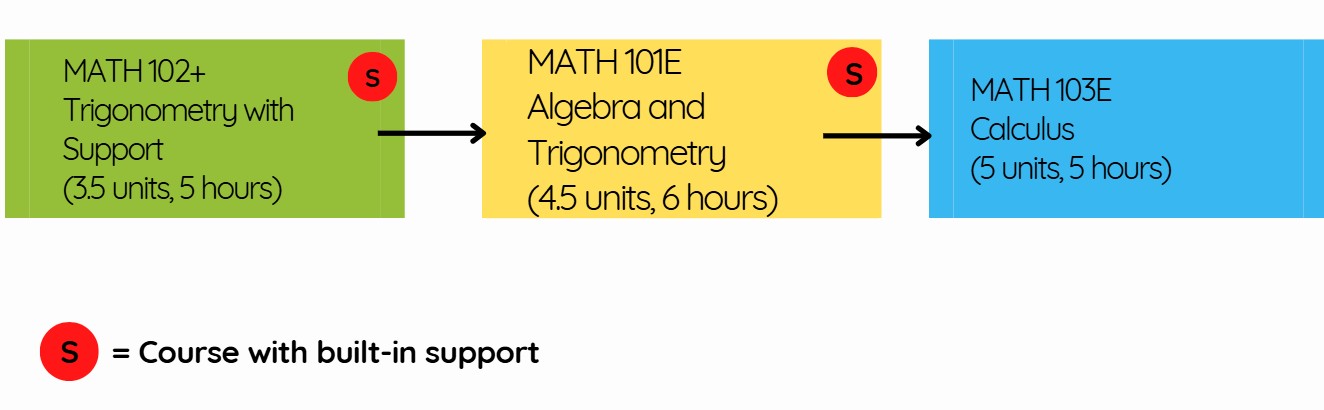
Below is the STEM-Calculus pathway.

 Calculus course sequence - Math 102+ then Math 101E then Math 103E

MATH 102+ is a transfer-level course in plane trigonometry with a built-in support lab component. The course emphasizes the analytic aspects of the subject. Topics include trigonometric functions of any angle, trigonometric identities, half-angles, trigonometric equations, applications of trigonometric functions, functions, complex numbers, and polar and parametric equations. The support lab topics include plane geometry, solving algebraic equations, simplifying algebraic expressions, coordinate plane, graphing techniques and basics of Trigonometry.

MATH 101E is a course that prepares students for calculus. Topics include polynomial, absolute value, radical, rational, exponential, logarithmic, trigonometric functions and their graphs, inverses, expressions, equations, inequalities, and trigonometric identities.

MATH 103E is the first of a sequence of three courses combining the subject matter of analytic geometry and calculus. Functions and their graphs are studied with special attention to differentiation, limits, rules and integration using various techniques. The calculus of inverse functions and transcendental functions as well as applications of differentiation is also covered.