A
BASE GLAZE is a glaze that contains sources of the three essential components of a glaze, (SILICA,
FLUX AND ALUMINA) and that contains no added color. Accordingly, it will be white
or clear when fired. To achieve colored glazes, first a satisfactory BASE GLAZE is
found which "fits" the clay body being used, and then tests are run adding various
blends of the following metallic oxide colorants:
| COBALT |
1½ |
reduction
|
blue, blue-violet
|
| COBALT |
1½ |
oxidation
|
blue, blue-violet
|
| IRON |
½-2 |
reduction
|
jade green, celadon
|
| IRON |
2-3 |
reduction
|
straw yellow |
| IRON |
3-4 |
reduction
|
golden orange
|
| IRON |
4-5 |
reduction
|
brick red, japan khaki
|
| IRON |
5-6 |
reduction
|
brown-black, temmoku
|
| IRON |
½-6 |
oxidation
|
amber to brown
|
| MANGANESE |
5-10 |
reduction
|
purple, eggplant brown
|
MANGANESE
|
5-10 |
oxidation
|
honey browns
|
CHROME
|
2-3 |
reduction
|
green
|
CHROME
|
2-3 |
oxidation
|
brown, pink, red, yellow
|
COPPER
|
2-3 |
reduction |
red, purple
|
COPPER
|
2-3 |
oxidation
|
turquoise blue, green
|
VANADIUM
|
5-10 |
reduction |
gray
|
These metallic oxides are added in the amounts indicated to suitable base glazes to
achieve colored glazes. Note that the type of firing employed will have a great influence
on the color achieved in the glaze. To read more about the effects of firing atmosphere
on glaze color go to
KILNS.
Here is an example of a typical base glaze formula and some possible oxide additions:
Feldspar 48.9g
Kaolin 25.1g
Dolomite 22.4g
Whiting
3.6g
100.0g
This is a classic BASE GLAZE. Note that there are sources of Silica (in the Feldspar
and the Kaolin), sources of Alumina (also in the Feldspar and the Kaolin), and fluxes
(the Dolomite, the Whiting, and flux present in Feldspar). It's color is white.
To turn this white, base glaze into a colored glaze we simply add colorants from the
list above, either singly or in combinations. For example:
- To this base glaze, add 1% cobalt oxide (in this case 1% of 100g is 1g) and now the
glaze color when fired is blue.
- OR add 3% chrome oxide
(in this case 3% of 100g is 3g) glaze color is now greenand the fired glaze color
is now green
- OR add 1% cobalt oxide (in this case 1% of 100g is 1g) AND 3% chrome oxide (in this
case 3% of 100g is 3g) and the fired color is blue green.
- Oxides can be combined in complex mixtures to create unusual colors. Glaze testing
is a challenging and rewarding area of study for any ceramic artist.
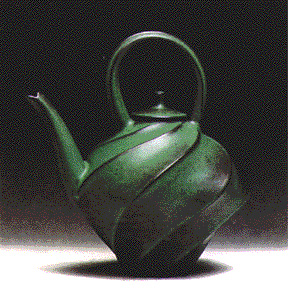
TEAPOT, JIM CONNELL, USA, 2005
Porcelain, wheel thrown and glazed with a chrome oxide green glaze fired in a reduction
atmosphere
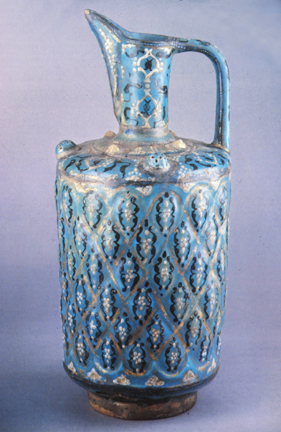
LAJVARDINA EWER, PERSIA, 1210 CE
Ewer (Pitcher), Wheel thrown earthenware with turquoise blue (lajvardina) glaze from
Kashan, a city which specialized in luster ware. The turquoise color of the glaze
results from copper oxide fired in an oxidation atmosphere.
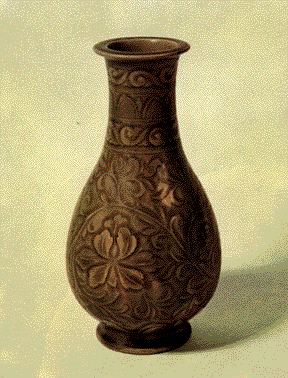
NORTHERN SONG DYNASTY VASE, CHINA, 1050 CE
incised porcelain with amber brown glaze from iron oxide fired in an oxidizing atmosphere
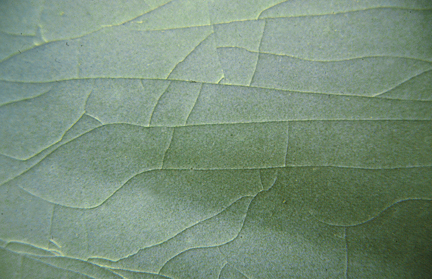
SOUTHERN SONG DYNASTY, 'RU' WARE CELADON, 1100 CE
Close up of the cicada's wing pattern in the blue-green celadon glaze. Iron oxide
impurities in the local glaze minerals result in this prized color when fired in reduction
atmospheres.
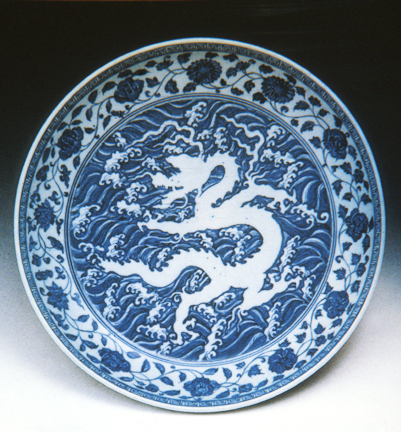
MING DYNASTY BLUE AND WHITE PLATE, CHINA, 1430 CE
Porcelain platter, wheel thrown with cobalt oxide painted design. Cobalt is a reliable
blue pigment in most firing atmospheres and temperatures, as in this example, fired
at highest temperatures in a reduction atmosphere. .
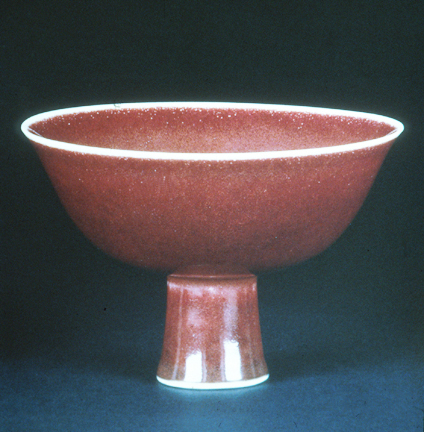
MING DYNASTY STEM CUP, CHINA, 1375 CE
Porcelain cup, wheel thrown in two pieces and joined. Inside the foot is a hidden
carved design (called 'an hua'), which can only be seen when the cup is held to the
light and the carved, translucent porcelain allows the light to penetrate. The blood
red glaze results from copper oxide added to the glaze and then firing in a reducing
atmosphere.
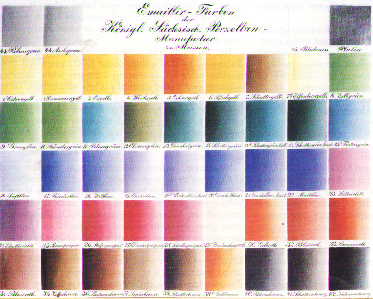
MEISSEN COLOR PALETTE, GERMANY, 1725 CE
European porcelain was developed hundreds of years after the Chinese had perfected
it during the Song Dynasty. The glaze alchemists at Meissen were able to create an
almost full palette of overglaze colors to use with their famous porcelain tableware
and display pieces that graced the tables and emptied the treasuries of European royalty.
GO TO TOP OF PAGE