Tutors are GCC students who have been recommended by their instructors. All tutors must complete the Tutor Training Seminar, a course in tutoring theory and strategies. Tutors receive supervision and ongoing instruction during their employment.

Yes.

We advise you make an appointment in advance to see a tutor. Although we will try to accommodate same day appointment requests, we cannot guarantee a tutor will be available.

Appointments are 30 minutes in length and are limited to 2 appointments per class, per week, on different days.

The common goal of all tutors is to help you become a more confident, independent learner. As such, allowing students to receive unlimited tutoring runs counter to this philosophy of fostering independence. Learning happens best when there is time to process information between tutoring sessions. Tutoring is only one step in the learning process, and students should be prepared to work independently in order to improve their skills.

 No.

Tutors will address several issues identified by your instructor on the tutoring referral form. Tutors stress that writing is a process with definite stages and will recommend proofreading strategies if necessary. They can point out patterns of errors within an essay, but they will not point out and correct all specific errors on a page; this is part of the student’s responsibility.

No.

We currently only provide tutoring to GCC students for the classes in which they are enrolled.

No.

Tutoring is funded by the college.

Sometimes we can extend your appointment if the tutor has an opening available. Please talk to a staff member before extending an appointment. Generally, appointments are not extended past 1 hour. The common thinking goes, "If some is good, more is better." If this were true, taking 20 ibuprofen for a headache would be a good idea. In fact, research indicates that sessions longer than 30 minutes do not improve outcomes (Leung 570). 

Our goal is to foster independent learning, and the best way to do that is to support you with critical concerns so you can practice on your own. Spacing out your studies, or interleaving, is proven to be more effective than trying to focus for long periods of time. So, it's much smarter to schedule two shorter appointments on two different days than to plow through extra long sessions in one sitting.

Leung, Kim C. "Preliminary Empirical Model of Crucial Determinants of Best Practice for Peer Tutoring on Academic Achievement." Journal of Educational Psychology, vol. 107, no. 2, 2015, pp. 558-579.

If you enjoy working with a particular tutor, we will try to accommodate you; however, we cannot guarantee you will be able to work with the same tutor each time.

Appointments will be held for 10 minutes at which time we reserve the right to give your appointment to another student. If you are late and another student has not taken your appointment, you can still use the time remaining in your 30 minute session. Based on availability, you may be able to book another appointment on the same day, but students who have not had an appointment that day will receive priority.

If a student schedules but does not attend a tutoring appointment, the student will receive a warning from the Learning Center staff, regardless of the justification, insofar as each no-show disrupts the operation of the Center. Another warning will be issued for the second no-show.

If a student schedules but does not attend a third tutoring appointment in the same term, the student will not be allowed to schedule another appointment for a period of seven days from the date the student is notified of the missed appointment.

If a student does not attend a fourth scheduled appointment in the same term, the student will not be allowed to schedule any more appointments during the term in question and must wait until the subsequent term in order to schedule tutoring appointments, at which time the student has a fresh start and the same series of ramifications as outlined in this paragraph apply.

If a tutor does not honor a tutoring appointment, the Learning Center manager shall handle the violation in accordance with Learning Center policy.

No.

The Learning Center does not offer private tutoring services or provide tutoring for elementary or high school students. If you are seeking a private tutor, please contact the Job Placement Center (818-204-1000, ext. 5194) and place an advertisement through them.

It is important that you always check in at the front desk when using the Learning Center. Your hours are recorded on the computer, and your instructor is able to view your hours online. If you do not check in, you will not receive credit.

There are several factors that affect the type of tutors we hire.

Due to ongoing budget issues, we are not able to provide tutors for all classes. Also, instructors do not always recommend tutors for their disciplines. Low demand is another reason why we might not hire a tutor for a particular class. Let us know if you need a tutor for a particular class, and we will try to accommodate you.

Yes! We are open to all GCC students who wish to study during our facility hours.

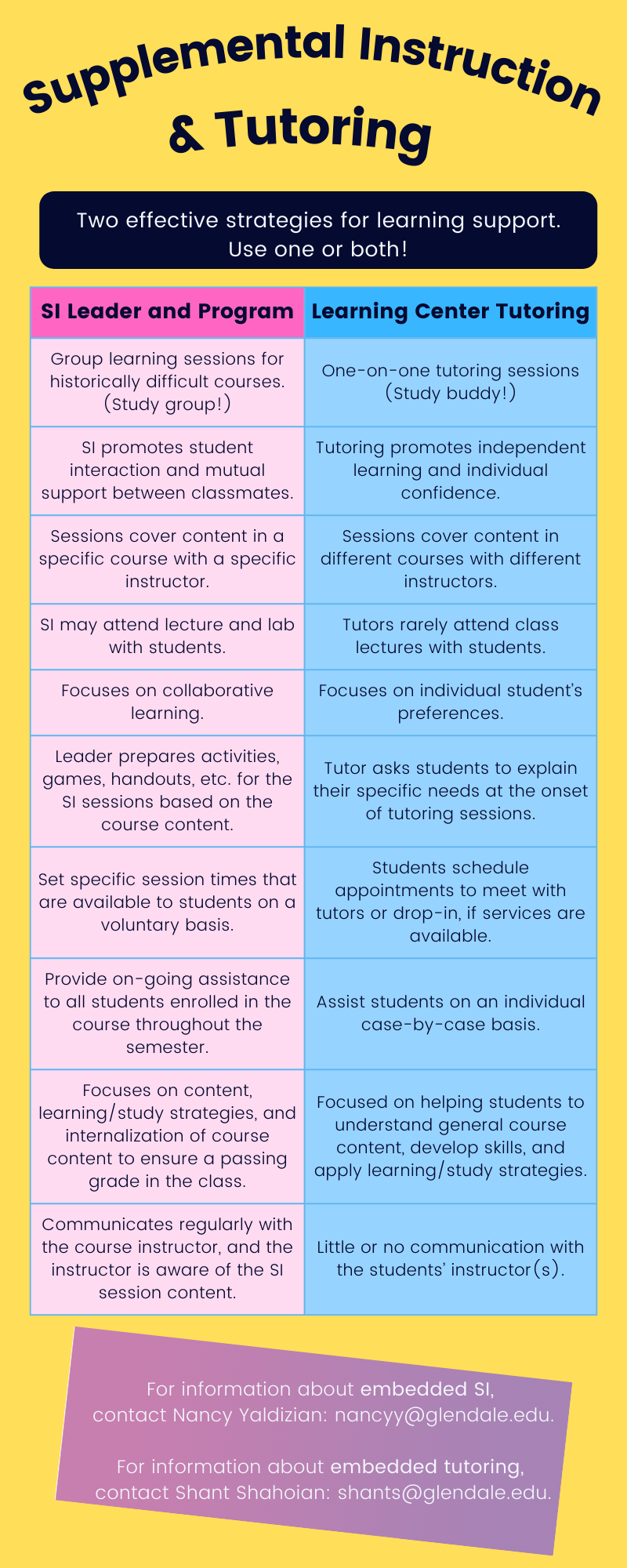
Differences between SI and Tutoring

Accessible text for graphic

The Learning Center provides an open and welcoming environment for students to use the resources and services that support study and learning. Conduct that interferes with the safe, peaceful, and orderly operation of the Center is not allowed. All students are expected to treat others respectfully and to follow rules and staff directions. In circumstances where these expectations are violated, the Learning Center reserves the right to restrict use and/or access to its services.

See: GCC Standards of Student Conduct - GCC Administrative Regulation 5500; and California Penal Code 626.6.

STUDENTS STANDARDS OF STUDENT CONDUCT - GCC Administrative Regulation 5500

The purpose of this procedure is to provide a prompt and equitable means to address

alleged student violations of the Standards of Student Conduct, and provide the

involved student or students their due process rights guaranteed by state and federal

constitutional protections. This procedure is not intended to substitute for criminal or civil

proceedings that may be initiated by other agencies.

Copies of the Standards of Student Conduct are available in the Student Affairs Office located in the J.W. Smith Student Center.

COMMUNITY MEMBERS California Penal Code 626.6

626.6. (a) If a person who is not a student, officer or employee of a college or university and who is not required by his or her employment to be on the campus or any other facility owned, operated, or controlled by the governing board of that college or university, enters a campus or facility, and it reasonably appears to the chief administrative officer of the campus or facility, or to an officer or employee designated by the chief administrative officer to maintain order on the campus or facility, that the person is committing any act likely to interfere with the peaceful conduct of the activities of the campus or facility, or has entered the campus or facility for the purpose of committing any such act, the chief administrative officer or his or her designee may direct the person to leave the campus or facility.


The Learning Center's policy on children is guided by Administrative Regulation 3825, which states the following: "Non student minors on campus are here at the risk of the supervising adult who brings them. Supervising adults are expected to maintain control of their minors to ensure they abide by the Standards of Student Conduct at all times while they are on campus. Both the minor and their supervising adult shall be subject to disciplinary action for any disruption of college services or activities. Unsupervised minors shall be detained by Campus Police until the supervising adult can be located."

Students caught or suspected of violating Glendale Community College's Policy on Academic Honesty will be asked to terminate their sessions - tutoring, computing, or studying - and their actions will be reported to their instructors.