Do you need help understanding Veterans benefits and the Forever GI Bill® No problem. The GCC Veterans Resource Center assists veterans on receiving your full set of VA benefits. It can be confusing the first time you are applying for veterans benefits. We are here to help you with this process. Veteran services are provided through the Office of Admissions and Records and Veteran Resource Center. Here, the veterans’ staff provides assistance to veterans and eligible dependents in qualifying for educational benefits and in planning educational programs.

GI Bill® is a registered trademark of the U.S. Department of Veterans Affairs(VA). More information about education benefits offered by VA is available at the official U.S. government Web site at benefits.va.gov/gibill.

Do I Renew My Benefits Each Semester?

It is the student’s responsibility to notify the Glendale Community College Veterans Center each semester that he/she wants his/her educational benefits to continue. It is not an automatic process.

You can read more about the different Chapters below and if you have any questions about VA benefits, don't hesitate to give us a call and ask for assistance.

Post-9/11 and Forever Gi Bill

The Post-9/11 GI Bill® (Chapter 33) helps you pay for school or job training. If you’ve served on active duty after September 10, 2001, you may qualify for the Post 9/11 GI Bill® (Chapter 33).

Requirements:

  • You served at least 90 days on active duty (either all at once or with breaks in service) on or after September 11, 2001, or
  • You received a Purple Heart on or after September 11, 2001, and were honorably discharged after any amount of service, or
  • You served for at least 30 continuous days (all at once, without a break in service) on or after September 11, 2001, and were honorably discharged with a service-connected disability, or
  • You’re a dependent child using benefits transferred by a qualifying Veteran or service member

Learn more on Post 9/11 GI Bill®.

The Montgomery GI Bill® often known as Chapter 30, provides education benefits to Veterans and service members who have at least two years of active duty

The way it works is it is determined by a rate which is based on 2 factors

  • The type of education or training you’re getting, and
  • How many courses you’re taking—or how far along you are in your on-the-job training or apprenticeship program

You may get less than the full rate each month if any of these are true:

  • You’re enrolled in fewer courses than what we consider to be full time, or
  • Your clock hours per week are less than what we consider to be full time, or
  • You’re getting on-the-job training, or
  • You’re in an apprenticeship program, or
  • You’ve served less than 3 continuous years on active duty

Learn more on the Montgomery GI Bill®.

Program provides education and training benefits to eligible members of the Selected Reserve, including the Army Reserve, Navy Reserve, Air Force Reserve, Marine Corps Reserve and Coast Guard Reserve, and the Army National Guard and the Air National Guard

Who is Eligible?

  • Must be in drill status in order to use benefits
  • Must have a six-year contract after June 30th, 1985 or for other types of training after September 30th1990
  • Must have completed 180 of duty in the selected reserve or guard
  • Must have GED or High School Diploma

Learn more on Selected Reserve

The Harry W. Colmery Veterans Educational Assistance Act, also known as the “Forever GI Bill®,” will bring significant changes to Veterans education benefits over the coming years.

Learn more on Forever GI Bill®

Forever GI Bill® Changes

The Forever GI Bill made a number of changes to veterans benefits. Make sure to check with us if you don't fully understand all the changes on the VA website. Some of the changes from the Forever GI Bill® include:

VA is now authorized to restore benefits and provide relief to education beneficiaries affected by school closures or certain disapprovals. This means payments of educational assistance will not be charged against an entitlement of educational assistance, or counted against the total period for which a beneficiary may receive educational assistance under two or more programs, if VA finds that the individual was unable to complete such course or program of study as a result of:

  • the closure of an educational institution; or
  • the disapproval of the course or a course that is a necessary part of that program by reason of a new law, regulation, or policy implemented after the individual enrolls.
  • not receiving credit, or losing training time, toward completion of the program being pursued.

Removes the time limitation for the use of Post-9/11 GI Bill® benefits for individuals whose last discharge or release from active duty is on or after January 1, 2013, children of deceased Service members who first become entitled to Post-9/11 GI Bill® program benefits on or after January 1, 2013, and all Fry spouses.

All others remain subject to the current 15-year time limitation for using their Post-9/11 GI Bill® benefits.

VA will improve outreach and transparency to Veterans and Service members by providing information on whether institutions of higher learning administer a priority enrollment system that allows certain student Veterans to enroll in courses earlier than other students. 

Members of the Reserve who established eligibility to educational assistance under the Reserve Educational Assistance Program (REAP) before November 25, 2015, and lost it due to the sunset provision may elect to have that service credited towards the Post-9/11 GI Bill® program. 

Beneficiaries will now be able to use their Post-9/11 educational assistance to pursue accredited independent study programs at the following educational institutions that are not institutions of higher learning (IHLs): area career and technical education schools that provide postsecondary level education and postsecondary vocational institutions. 

Removes the expiration date of June 30, 2022, for certain qualifying work-study activities for which an individual may be paid an additional educational assistance allowance. These activities include outreach services for an SAA, providing hospital and domiciliary care and medical treatment to Veterans in a State home, or performing an activity relating to the administration of a national cemetery or a state Veterans' cemetery.

For more information on the changes from the Forever GI Bill® visit the VA Benefits website.

If you’re a service member or Veteran and have a disability that was caused—or made worse—by your active-duty service and that limits your ability to work or prevents you from working, you may be able to get employment support or services to help you live as independently as possible.

  • The requirements for the VR&E program are
  • Must not have a dishonorable discharge
  • Must have at least a rating of 10% or higher
  • Must have at least one day in the books under Post 9-11 GI Bill®
  • If you were discharged from active duty on or after January 1, 2013, the 12-year basic period of eligibility doesn’t apply to you. There’s no time limit on your eligibility.

Learn more on Vocational Rehab

If you’re a dependent or surviving spouse of a Veteran, you may be eligible for VA education benefits. If you qualify for both Survivors’ and Dependents’ Education Assistance (DEA) and the Fry Scholarship, you’ll have to pick one or the other when you apply. After you’ve made this decision, you can’t switch. But you can use transferred benefits with both DEA and the Fry Scholarship.

Eligibility requirements for Chapter 35:

  • The Veteran is permanently and totally disabled due to a service-connected disability, or
  • The Veteran died as a result of a service-connected disability, or
  • The service member died in the line of duty, or
  • The service member is missing in action or was captured in the line of duty by a hostile force for more than 90 days, or
  • The service member was forcibly detained (held) or interned in the line of duty by a foreign entity for more than 90 days, or
  • The service member is in the hospital or getting outpatient treatment for a service-connected permanent and total disability and is likely to be discharged for that disability

Must apply at ( https://www.va.gov/education/survivor-dependent-benefits/dependents-education-assistance/).

Learn more on Dependents GI

The College Tuition Fee Waiver for veteran dependents benefit waives mandatory system-wide tuition and fees at any State of California Community College, California State University, or University of California campus. This program does not cover the expense of books, parking or room and board. There are four plans under which dependents of veterans may be eligible.

https://www.calvet.ca.gov/VetServices/Documents/DVS%2040.pdf

https://www.calvet.ca.gov/VetServices/Pages/CVSO-Locations.aspx

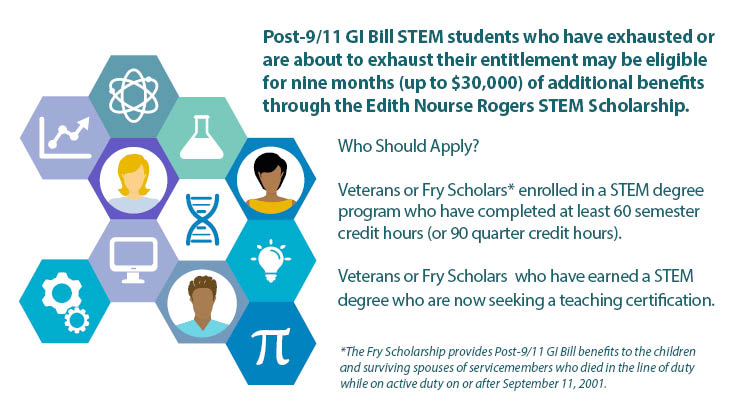
VA has launched the Edith Nourse Rogers STEM Scholarship program for students training in high demand STEM (Science, Technology, Engineering, and Math) fields.

The Rogers STEM Scholarship will provide up to nine months of additional Post-9/11 GI Bill® benefits (to a maximum of $30,000) to qualifying Veterans and Fry Scholars seeking an undergraduate STEM degree or who have earned a STEM degree and are seeking a teaching certification.

STEM Graphic with scientific symbols such as gears, beakers and computer screens

for more information on who is eligible for the Rogers STEM Scholarship?

The Veterans Resource Center does NOT report fees until the end of the semester to stay in accordance with the Federal law.

  1. Federal Law and "Last Payer" Rule:
  • VA as the Last Payer: Federal law requires that the VA be the last payer for tuition and fees. This means that any financial aid, including grants, scholarships, and loans, must first be applied to your tuition and fee balance before VA benefits are used.
  • Purpose of Delay: By waiting until the end of the semester to report fees, the Veterans Resource Center ensures that all other forms of financial aid are applied first, as required by law. This avoids any premature use of VA benefits that could lead to overpayments or complications.

1). Benefits Limitations on Academic Probation:

  • Duration: VA education benefits can be utilized while on academic probation for up to two semesters.
  • Third Semester: If academic probation extends into a third semester, VA benefits will not be certified for that term.
  • Contact the Veterans Resource Center: Reach out to the Veterans Resource Center as soon as you’re placed on academic probation. They can provide valuable support and resources to help you improve your academic performance and address the issues causing probation.

  • Academic Counseling: Seek guidance from academic counselors who can help you develop a plan to get back on track.
  • Tutoring Services: Utilize tutoring services to assist with coursework and enhance your understanding of challenging subjects.
  • Study Skills Workshops: Participate in workshops designed to improve study habits, time management, and test-taking strategies.
  • Mental Health Support: If personal or mental health issues are affecting your academic performance, consider accessing counseling and mental health resources offered by the center.

  • Create a Plan: Work with an advisor to create a detailed action plan aimed at improving your grades and academic standing.
  • Set Goals: Establish short-term and long-term academic goals, and regularly review your progress towards achieving them.

  • Keep Records: Document any steps you take to address academic probation, such as meeting with advisors or attending support services.
  • Update the Veterans Resource Center: Keep the center informed about your progress and any changes in your academic situation.

  1. Monitor Progress: Stay vigilant about your academic performance and ensure that you meet the required standards to avoid further issues.
  2. Consider Alternatives: If challenges persist, discuss alternative educational paths or career options with your academic advisors.
  3. Veterans Resource Center: Reach out to the center via their website, phone, or in person. They are there to help you navigate the impact of academic probation on your VA benefits and to provide the support needed to improve your academic progress.

By taking these steps and leveraging the resources available to you, you can work towards resolving academic probation and maintaining your eligibility for VA education benefits.

Note: GI Bill® is a registered trademark of the U.S. Department of Veterans Affairs(VA). More information about education benefits offered by VA is available at the official U.S. government Web site at benefits.va.gov/gibill.